Washington Chapter FNAWS
Banquet Auction Hunt: A
SUCCESS!
By Jerry Terrell
I purchased the hunt at the Washington
FNAWS banquet in February for the 1995 season. The hunt was sold as a
sheep hunt if a tag was drawn in the Delta permit area. Grizzly bear would
be substituted if the drawing was not successful. Alaska does not draw
controlled hunts until July, so it was an anxious seven months of waiting.
The drawing date finally arrived and the results were not worth waiting
for... I was unsuccessful!
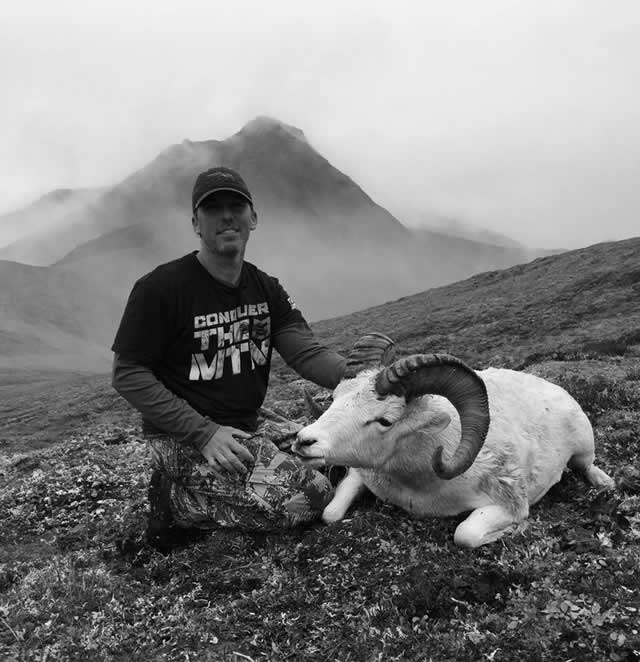
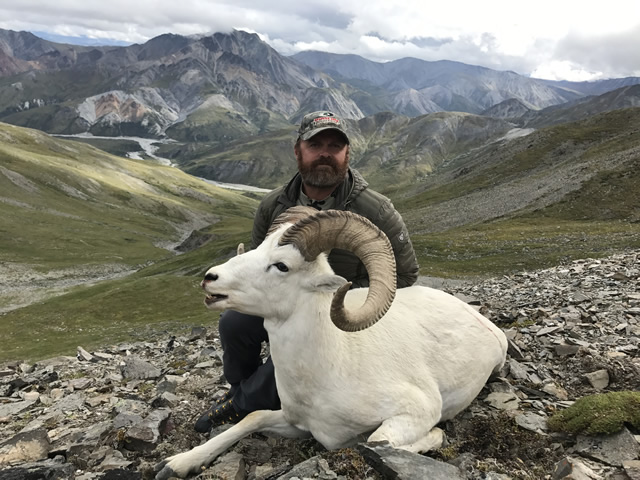
Jerry Terrell and his
Alaska Range Dall ram.
Photo by Deltana Outfitters
To
say I was disappointed is an understatement, as I had no interest in a
grizzly hunt. Ralph Miller, the owner of Deltana Outfitters, had made it
clear the hunt was to be held in the 1995 season with no substitution, so
I held little hope of hunting sheep in his non-permit area, but that
changed after having an opportunity to meet Ralph while on a business trip
to Alaska.
Ralph graciously offered to take me in his non-permit area if I
wanted to wait for the 1996 season. I decided to accept before he changed
his mind. Ralph made it clear this would be a backpack hunt on a glacier
and would be, as he put it, physically challenging. He also said he had
room for one more hunter, so I talked Mike Smith, a friend from Reno,
Nevada, into making the trip with me.
Ralph's comment about physically
challenging was in the back of my mind for the rest of the year and served
as a lever to keep me on a workout schedule that would hopefully enable me
not to embarrass myself. The year passed quickly and it was soon time to
head to Alaska.
Mike and I met in Seattle, flew to Anchorage and drove to
Delta. The next day we flew into base camp by Super Cub and met our guides
Mike (Ollie) North and Kent Monroe. We decided to make a pack and set up
our spike camp, which was an easy six-mile walk but quickly turned into
twelve miles when we decided to return to the base camp and make one more
pack the following morning.
We saw one band of six rams on our second
hike in, and after we set up the spike camp and got organized, we spotted
another group of fifteen rams. The sheep were across a glacier
Sheep spike camp
approximately three miles away so it was difficult to judge horn size, but
several looked to be full curl and one was broomed and heavy, just what I
was looking for. The decision was made to cross the glacier the following
day and get a closer look at the sheep. I found out glaciers are
deceiving, what looks flat and easy going from a distance, is not so!
Three and one half hours were required to cross the three mile distance,
but we finally got into position to glass our mountain side. The day was
spent glassing without success, our rams were nowhere to be seen. We were
a dejected group as we returned across the glacier to camp. We had just
finished crossing the glacier and climbing the last moraine when I decided
to glass the mountain one last time. You guessed it, the sheep were
feeding just around the bend of the mountain and out of sight from our
earlier vantage point. We hoped our luck would change before the hunt was
over.
Day four found us hunting the group of six
rams we had spotted close to camp and glassing the large group across the
glacier. The easy-to-reach group contained six rams which were all about
the same age and 7/8 curl. We did manage to find a better spot to glass
the large group and spent most of the day watching them feed. We also
determined there were at least five legal rams in the group. We had hit
the jackpot!
Day five found us crossing the glacier for
the third time, but we decided to move our camp and take enough food for
five days in case the sheep pulled another disappearing act. We managed to
cross the glacier in record time and quickly set up our spotting scopes
around the corner from our original spot.
The band of rams were quickly spotted in
two separate groups about 400 yards apart and 1000 yards from our vantage
point. The good news was they were feeding close to the bottom of the
mountain and a moraine that paralleled the base of the slope would provide
cover to within 200 yards of both groups of rams
.if they didn't feed up
hill too far. We set up the spotting scopes looking for that magic 40' ram
or one that was old, heavy and broomed. None of the first group fit the
description but several appeared to be mature, full-curl rams. The scopes
were trained on the second group and one ram stood out. He was not the
40" sheep I was dreaming of but he was old , heavy and broomed with
exceptionally dark horns. The old ram had a group of five rams with him,
one of which appeared to be larger than any in the first group. The
decision was quickly made to try for the two larger rams in the second
group before they fed up the mountain. We slipped behind the 100 ft.
moraine, picked out a large boulder as a land mark and headed toward the
sheep at a fast pace. We stopped before we got to our landmark to check
out the first group and much to our surprise both groups had fed into the
same area. We now were looking at one group of fifteen sheep, all rams!
The sheep were approximately 400 yards off and feeding slowly away so Mike
and I quickly got in position for a shot. There were at least five full
curls in the group and it seemed to take an eternity to get organized and
decide which sheep were the largest of the group. This was made more
difficult by the fact that there were sheep with convergent and divergent
horns in the herd. I found the broomed ram, and Mike picked one that
looked to be the largest of the group. My sheep finally turned broadside
so I decided to shoot before they moved any further up the mountain. The
shot was good and the sheep rolled 100 feet down the mountain.
The remaining sheep milled around for a
minute and resumed feeding, giving Mike an opportunity to shoot. We soon
found out Mike damaged his scope in a fall crossing the glacier, the first
two shots were clean misses but the third shot connected and the ram went down hard. The celebration was on: it's not every day that a plan comes
together as ours had--at least that's what we thought until Mike's ram got
up and started running! The chase was on. Mike and his guide, Kent,
scrambled up the mountain after his ram and Ollie and I decided to take
care of my ram and packed him back to our spike camp.
Guide
Ralph Miller (left) and assistant guide Jim Weidner with a load of sheep
horns in the Alaska Range. Photo by Deltana Outfitters.
Several hours later the look on Mike and
Kent's face told the story--the ram had gotten away but not before several
more shots were fired. After we got back to the spike camp we ate a quick
meal and started glassing. A Ram was soon spotted bedded in the rocks
about 1500 vertical feet above camp. A quick look with the spotting scope
confirmed it was a full curl with flaring horns and looked like the ram
Mike had wounded earlier in the day. Mike and Kent decided there was not
enough daylight for a stalk and we went to bed hoping he would be there in
the morning.
The pack across the glacier, the quick trip
down the moraine, combined with a cold drizzle, made a warm sleeping bag
and a dry two-man tent seem like a suite at the Ritz and I don't think
anyone moved until first light the next morning. Mike was the first to the
spotting scope and his sheep was still there! A stalk was planned and he
and Kent started climbing. The ram cooperated, staying in his bed and
after a one and one-half hour climb he was able to get above the sheep and
stalk within 50 yards. One shot from my borrowed .280 and Mike had his
ram. Further examination showed that it was the sheep wounded the day
before which explained why he stayed in his bed for an extended period. We
were all ecstatic that we had taken the wounded sheep and that Mike had
his first ram, an eight year old, wide, flaring beauty. Ecstasy soon
turned to agony as the glacier had to be crossed and the nine-plus miles
to main camp had to be negotiated. The glacier that took three hours to
cross with camp gear on our back took five hours with our heavier loads.
The final six miles back to main camp was easy going but seemed to take
forever with the heavy packs, but is sure made a cold drink and a camp
stool seem like a real luxury. Dinner of sheep backstrap that night was
even more of a luxury after five days of freeze dried food.
The next five days were spent trying to
stay dry and hoping the weather would clear long enough to get the Super
Cub into camp.
I would like to thank Ralph and his guides
for a great hunt and encourage anyone interested in a great fair chase
sheep, caribou, moose, or bear hunt to contact Ralph at:
Jerry Terrell is a vice-president of the
Washington State Chapter of the Foundation for North American Wild Sheep,
187815 Pacific Ave, Spanaway, WA 98387. Terrells group is affiliated
with the national FNAWS,
720 Allen Ave, Cody, WY 82414 (307) 527-6261. |